God made the Earth. Apparently he forgot its shape.
Four corners, graspable ends, pillars, a worldwide-visible tree, and a mountain showing every kingdom. A literal reading of biblical cosmology, with KJV quotations, a passage index, and a satirical meme of God getting his own planet wrong.
The Earth has no four corners. You cannot climb a mountain and see every kingdom on the planet. You cannot grow a tree so tall that ordinary observers everywhere on Earth can see it. The planet gets in the way.
Yet the Bible gives us corners, ends, a circle, pillars, foundations, and a mountain with a worldwide view. Read those descriptions as literal geography and they fail. An all-knowing creator should know the shape of his own creation.

Read the physical descriptions as physical claims. Calling a passage poetry, prophecy, or a dream does not make its imagined geography accurate. Those labels remain relevant to identifying what the text says, so they appear below without being used to rescue the literal claim.
Earth is approximately an oblate spheroid, with an equatorial bulge and an irregular surface. Globe is a useful shorthand. The scientific objection here concerns corners, terminal edges, and impossible sightlines, not the difference between a perfect sphere and the real planet. NOAA's account of Earth's shape.
Four corners, apparently installed by the manufacturer
Isaiah 11:12 promises to gather Judah's dispersed people:
from the four corners of the earth.
No verified chapter link available.
Revelation 7:1 supplies an even more physical scene:
four angels standing on the four corners of the earth, holding the four winds of the earth
No verified chapter link available.
A globe has no corners on which an angel could stand. North, south, east, and west are directions. Naming four directions does not manufacture four vertices on a curved surface. If the corners are literal, the geometry is wrong.
Revelation 20:8 is another relevant passage. The KJV uses quarters rather than corners.
And shall go out to deceive the nations which are in the four quarters of the earth, Gog and Magog, to gather them together to battle: the number of whom is as the sand of the sea.
The NIV translation of the same verse uses the corner wording.
four corners of the earth
No verified chapter link available.
Four regions can exist on a globe. Four physical corners cannot. The objection depends on which wording is being defended literally.
Ezekiel 7:2 also uses corner language.
Also, thou son of man, thus saith the Lord GOD unto the land of Israel; An end, the end is come upon the four corners of the land.
Its opening addresses the land of Israel. That makes it a related example of corner language, rather than an unambiguous statement that the entire planet is a square.
The Bible never says here that Earth has four equal sides. A square Earth in the meme is a caricature of the corner imagery. The literal defect needs no invented quotation. An Earth with actual corners already fails the globe test.
An Earth with ends you can grab
Job 38:12-14 puts the description in God's own speech about the dawn:
That it might take hold of the ends of the earth, that the wicked might be shaken out of it?
The next verse says:
It is turned as clay to the seal; and they stand as a garment.
Taken physically, this is an Earth with graspable extremities, something that can be shaken like a cloth. A globe's surface has no terminal edge to grab. The clay-and-seal comparison also evokes a surface receiving an impression. It does not explicitly say flat disk, and the criticism does not need to pretend it does. The edge-grabbing description is the clearer problem.
The end-language recurs elsewhere. Job 28:24 says God looks to the ends of the earth. Job 37:3 sends lightning there. Isaiah 40:28 gives God this title.
Creator of the ends of the earth
No verified chapter link available.
Deuteronomy repeatedly speaks of one end of the earth and the other.
Literal planetary ends are absent from the actual planet. A bounded country has extremities. A journey has a destination. Neither supplies an edge to the whole Earth's continuous surface. The index below collects the spatial end-language across the 66-book KJV, rather than stopping at the most frequently quoted examples.
A circle does not establish a globe
Isaiah 40:22 combines a circular Earth with an overhead tent.
It is he that sitteth upon the circle of the earth, and the inhabitants thereof are as grasshoppers; that stretcheth out the heavens as a curtain, and spreadeth them out as a tent to dwell in:
A circle is two-dimensional. A sphere is three-dimensional. A circular horizon is also compatible with a globe, so circle alone cannot prove a flat Earth. It equally fails as a clear statement that Earth is spherical. Reading circle as a literal description of the whole planet's shape gives us the wrong geometric object.
Proverbs 8:27 describes a circular boundary.
When he prepared the heavens, I was there: when he set a compass upon the face of the depth:
Here the relevant picture is a circular boundary, not a modern navigation instrument. Job 26:10 supplies a related boundary description.
He hath compassed the waters with bounds, until the day and night come to an end.
Other translations make the circle or horizon explicit. These are related boundary descriptions, not explicit declarations that the planet is a disk.
Isaiah 42:5 describes God spreading out the earth.
he that spread forth the earth
No verified chapter link available.
Isaiah 44:24 gives God this description of his work.
that spreadeth abroad the earth by myself
No verified chapter link available.
Psalm 136:6 describes the earth stretched out above the waters.
Read as construction instructions, that language suggests a spread-out surface. It supplies no explicit account of a globe. The disk interpretation is an inference from the imagery, and deserves that label.
The planet is apparently a building
1 Samuel 2:8 gives the clearest support structure:
for the pillars of the earth are the LORD's, and he hath set the world upon them.
No verified chapter link available.
Job 9:6 describes the earth shaken out of place and its pillars trembling. Psalm 75:3 has the speaker bearing up its pillars.
Earth is not a platform resting on architectural columns. These passages describe its support rather than directly naming its shape, but they belong in the same literal cosmology. A planetary interior is not a row of pillars beneath a world-floor.
In Job 38:4-6, God asks where Job was when he laid Earth's foundations. He mentions measurements, a stretched line, fastening the foundations, and laying its cornerstone. The cosmic architect sounds very impressed with his masonry.
Psalm 104:5, Isaiah 48:13, and Hebrews 1:10 repeat the foundation language. Psalm 24:2 says the earth was founded upon the seas and established upon the floods.
Neither foundations nor pillars mathematically prove flatness. They describe a built and supported world. Defending them as literal planetary engineering produces another mismatch with the actual Earth.
The mountain with a view around the planet
Matthew 4:8 says:
Again, the devil taketh him up into an exceeding high mountain, and sheweth him all the kingdoms of the world, and the glory of them;
No mountain offers that view. Climbing higher expands your horizon. It never removes the planet between you and the far side. Even from far above Earth, one ordinary viewpoint cannot see the entire solid surface at once.
The mountain is not itself said to be visible everywhere. It is presented as the place from which Jesus is shown all kingdoms. That is the exact sightline claim under examination.
Luke 4:5 repeats the worldwide display and includes a high mountain in the KJV.
And the devil, taking him up into an high mountain, shewed unto him all the kingdoms of the world in a moment of time.
Several modern translations omit the mountain because their underlying text differs. Matthew's mountain remains explicit.
A supernatural display could bypass ordinary optics. But that explanation adds a mechanism beyond a mountain's physical view. Under the literal geographical reading being tested here, the mountain cannot do the job. An omniscient author should know why.
The tree you could supposedly see from everywhere
In Daniel 4:10-11, Nebuchadnezzar describes a tree in the midst of the earth:
The tree grew, and was strong, and the height thereof reached unto heaven, and the sight thereof to the end of all the earth:
Daniel 4:20 repeats the tree's worldwide visibility.
The tree that thou sawest, which grew, and was strong, whose height reached unto the heaven, and the sight thereof to all the earth;
These are two appearances of the same tree, and both belong in the inventory.
There is no height at which a tree rooted on one side of a globe becomes directly visible to ordinary ground-level observers everywhere, including the opposite side. Increasing the height does not make light pass through the Earth. A flat plain at least avoids that particular obstruction, although atmosphere and distance still create problems.
Daniel introduces the scene as a dream and identifies the tree with the king in verses 20-22. The text does not report a botanist discovering an actual worldwide-visible tree. The literal criticism concerns the geometry of the pictured world. That geometry fails even if the dream has a political meaning.
God can apparently send a dream about imperial power, but the dream's tree still needs a planet with the wrong sightlines.
The roof and the immovable floor
The surrounding cosmology adds more physical trouble when read literally. Genesis 1:6-8 places a firmament between waters below and waters above. Genesis 1:14-17 places the lights in that firmament.
Job 37:18 describes a solid sky.
Hast thou with him spread out the sky, which is strong, and as a molten looking glass?
Job 26:11 gives heaven pillars. Psalm 148:4 still has waters above the heavens. Genesis 7:11 and 8:2 describe heaven's windows opening and closing around the flood. Amos 9:6 contributes upper stories, with several translations describing a vault over the earth.
These verses describe the sky and the arrangement of the world rather than explicitly naming Earth's shape. Taken together with the spread-out land and supports, they suggest a roof over a world-floor. That reconstruction is an inference, not a diagram printed in Genesis.
1 Chronicles 16:30, Psalm 93:1, and Psalm 96:10 say the world is established so that it cannot or shall not be moved. Psalm 104:5 says it should not be removed forever. These are motion and stability claims, not geometric definitions. A literal immobile planet nevertheless conflicts with Earth's rotation and orbit. NASA's Earth facts.
The familiar picture is a supported world beneath an overhead heaven. It works as an ancient imagined setting. It fails as a literal description of our planet.
The verses that deserve a more precise objection
Job 26:7 describes an unsupported Earth.
He stretcheth out the north over the empty place, and hangeth the earth upon nothing.
That is no statement of Earth's shape. It also creates tension with a literal world resting on pillars. A floating disk and a floating globe are both logically possible descriptions of something unsupported, so this verse settles neither geometry.
Job 38:18 asks about Earth's breadth. Revelation 20:9 describes people moving over its breadth. Globes have measurable widths. Breadth alone does not prove a flat planet.
Revelation 1:7 describes universal seeing.
Behold, he cometh with clouds; and every eye shall see him, and they also which pierced him: and all kindreds of the earth shall wail because of him. Even so, Amen.
Read as simultaneous ordinary sight of a localized figure in the clouds, that has the same globe obstruction. The verse itself does not specify ordinary optics or an exact viewing instant. Matthew 24:30 is related worldwide seeing language. These belong among the visibility questions, not among explicit shape definitions.
Acts 10:11 mentions a sheet with four corners descending to Earth. The sheet has the corners. Quoting it as if those corners belong to the planet would be a mistake.
The objection loses nothing by getting those details right. The explicit Earth-corner passages and the impossible ordinary mountain and tree sightlines remain.
Passage index
This inventory uses the 66-book KJV as its main searchable corpus. It groups direct geometric language, literal physical implications, and related cosmology so that readers can see the difference. Other translations can introduce corners, edges, circle, or vault where the KJV uses different words. No translation-independent inventory can be exhaustive just by searching one English phrase.
Corners, circular boundaries, spreading, and breadth
- Corners or quarters. Isaiah 11:12; Ezekiel 7:2; Revelation 7:1; Revelation 20:8. Ezekiel concerns Israel's land. Revelation 20:8 has quarters in the KJV.
- Circle or circular boundary. Isaiah 40:22; Proverbs 8:27; Job 26:10. The latter two concern the waters or depth.
- Spread-out earth above waters. Isaiah 42:5; Isaiah 44:24; Psalm 136:6. Psalm 24:1-2 adds earth founded on seas.
- Graspable ends and clay impression. Job 38:12-14.
- Breadth. Job 38:18; Revelation 20:9. These words alone establish no non-globe shape.
Pillars and foundations
- Earth's pillars. 1 Samuel 2:8; Job 9:6; Psalm 75:3.
- Earth's or the world's foundations. 2 Samuel 22:16; Job 38:4-6; Psalm 18:15; Psalm 82:5; Psalm 102:25; Psalm 104:5; Proverbs 8:29; Isaiah 24:18; Isaiah 40:21; Isaiah 48:13; Isaiah 51:13; Isaiah 51:16; Jeremiah 31:37; Micah 6:2; Zechariah 12:1; Hebrews 1:10.
- Heaven's pillars or foundations. Job 26:11; 2 Samuel 22:8. These concern the overhead structure, not Earth's geometric shape.
- The unsupported Earth. Job 26:7. Included because a literal reading must reckon with it alongside the pillar passages.
Sightlines, sky structure, and immobility
- All kingdoms shown from a mountain. Matthew 4:8; Luke 4:5 in the KJV.
- Worldwide-visible tree. Daniel 4:10-11; Daniel 4:20. Daniel 4:21-22 supplies its dream interpretation and worldwide dominion language.
- Worldwide seeing. Matthew 24:30; Revelation 1:7.
- Firmament, overhead waters, windows, roof, and heavenly stories. Genesis 1:6-8; Genesis 1:14-17; Genesis 7:11; Genesis 8:2; Job 22:14; Job 37:18; Psalm 104:2-3; Psalm 148:4; Isaiah 40:22; Amos 9:6.
- Fixed world. 1 Chronicles 16:30; Psalm 93:1; Psalm 96:10; Psalm 104:5.
Spatial ends of the earth or world
These are the spatial occurrences of end, ends, uttermost part, uttermost parts, or utmost parts of the earth or world in the searched KJV text. They are listed as literal edge-language candidates. A reference to the extremity of an inhabited territory does not by itself assert that the planet has a terminal edge.
- Deuteronomy 13:7; 28:49; 28:64; 33:17.
- 1 Samuel 2:10.
- Job 28:24; 37:3; 38:13.
- Psalms 2:8; 19:4; 22:27; 46:9; 48:10; 59:13; 61:2; 65:5; 67:7; 72:8; 98:3; 135:7.
- Proverbs 17:24; 30:4.
- Isaiah 5:26; 24:16; 26:15; 40:28; 41:5; 41:9; 42:10; 43:6; 45:22; 48:20; 49:6; 52:10; 62:11.
- Jeremiah 10:13; 16:19; 25:31; 25:33; 51:16.
- Daniel 4:11; 4:22.
- Micah 5:4; Zechariah 9:10.
- Matthew 12:42; Luke 11:31; Mark 13:27; Acts 1:8; Acts 13:47; Romans 10:18.
Some end-language refers to the end of an age. Matthew 13:39 and 28:20, for example, are temporal end-language and are excluded from this spatial list. Some foundation-language likewise refers to creation's beginning. Those formulaic occurrences are not presented as separate architectural descriptions.
The KJV corpus used for the scan is available in the aruljohn Bible repository. Readers can open the individual chapters through Bible Gateway's KJV search. The scan establishes coverage of the named English phrases, not every possible rendering in every biblical canon.
Omniscience with a geometry problem
These passages do not form one consistent engineering manual. Their images vary. That is exactly what one expects from human authors describing the world with inherited stories and familiar physical pictures.
The difficulty belongs to the claim that these physical descriptions must be literally accurate because their ultimate author knows everything. The actual Earth supplies a straightforward check. It has no corners to stand on or ends to shake. Its curvature blocks the mountain's worldwide view and the tree's worldwide visibility.
Metaphor changes the kind of claim being made. It does not make literal corners appear. Miracle changes the physical mechanism. It does not turn a mountain into a working global observation platform under ordinary optics. This article tests the literal geographical claims, and they fail that test.
God can get credit for creating the universe when he can describe the planet without needing his readers to repair the geometry.
Open or download the Earth-shape meme.
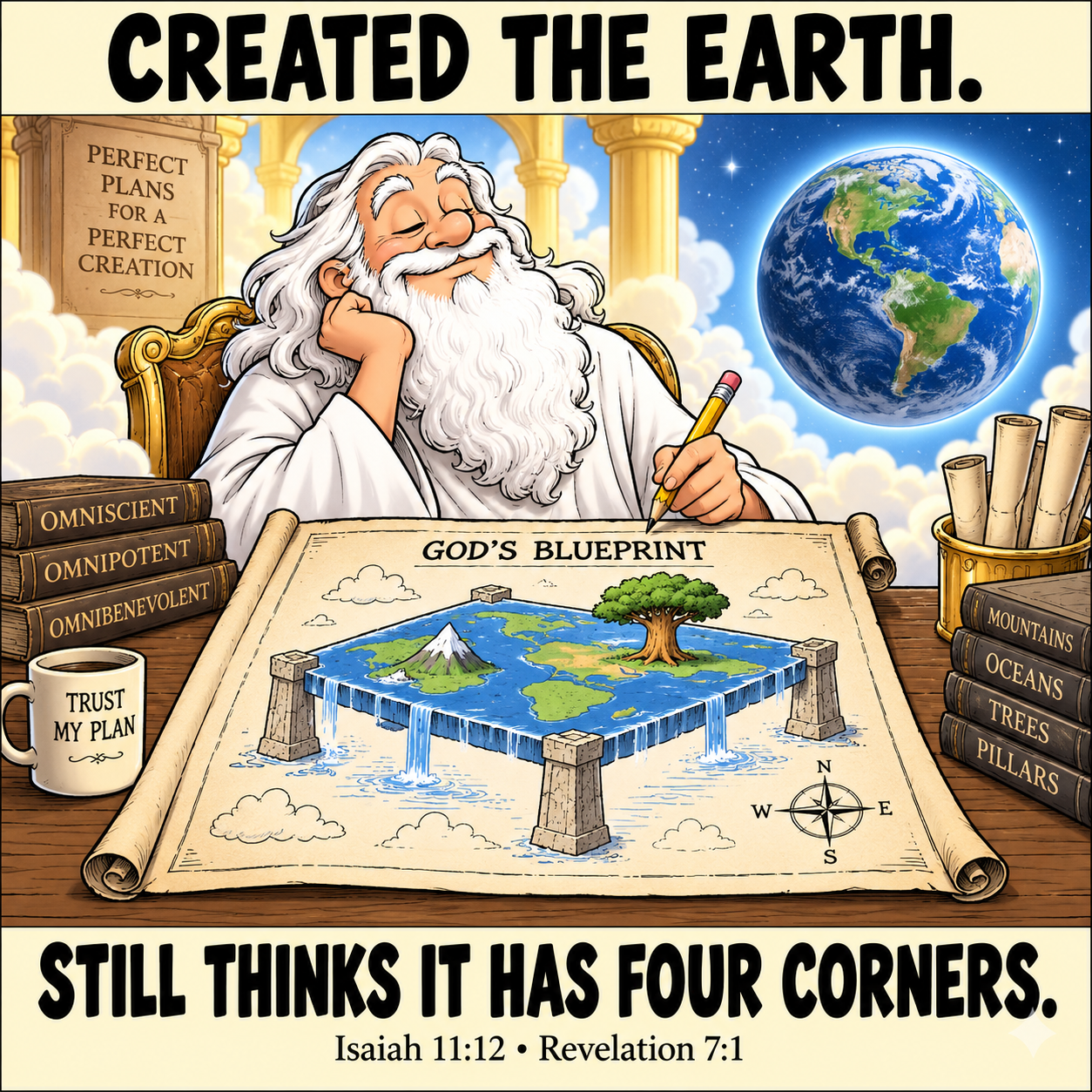
The meme combines the Bible's corners, pillars, mountain, and tree into a deliberately absurd blueprint. The headline mocks the supposed omniscient creator. The square is satire, not a claim that a verse explicitly calls Earth a square.